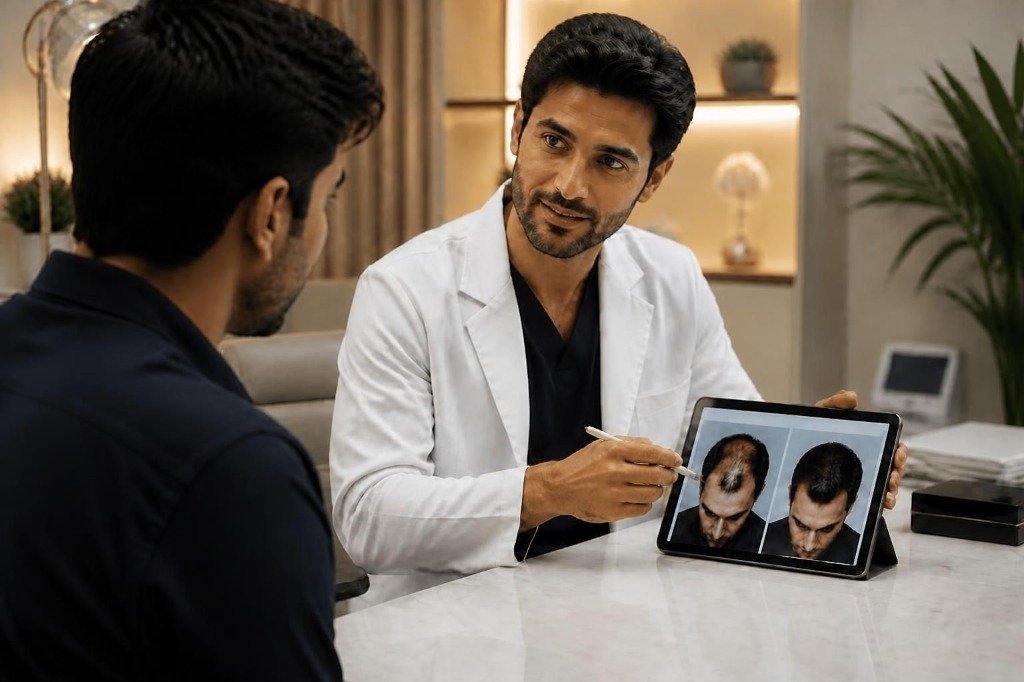
Comprehensive Hair Transplant Guide
An objective medical overview of surgical hair restoration: physiological mechanisms, candidate evaluation, surgical methodologies, and postoperative healing milestones.
How Hair Restoration Works
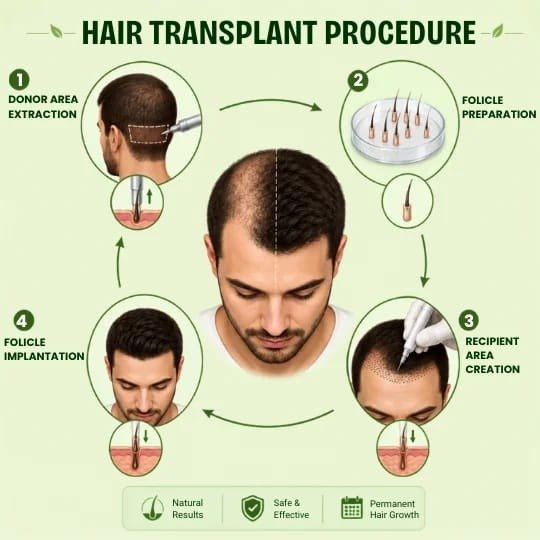
Androgenetic alopecia (pattern hair loss) occurs when genetically susceptible scalp hair follicles miniaturize under the influence of the androgen hormone dihydrotestosterone (DHT).
Crucially, follicles located across the occipital and parietal regions (the permanent donor zone at the lower back and sides of the head) lack the cellular receptors that trigger DHT sensitivity.
When these resistant follicular units are meticulously extracted and transplanted to thinning areas, they retain their intrinsic genetic resilience. Once healed and established, they produce permanent, natural hair for a lifetime.
Are You a Good Candidate?
Successful hair restoration requires realistic expectations and sufficient biological donor capacity.
1. Donor Area Density
The permanent donor zone must contain adequate follicular density (ideally 70+ follicular units per cm²) to safely supply recipient sites without causing visible thinning in the back.
2. Stability of Hair Loss
Candidates with stabilized hair loss patterns—often supported by medical therapy—achieve more predictable, harmoniously aged long-term aesthetic outcomes.
3. Scalp Health & Elasticity
A healthy scalp free of active inflammatory dermatological conditions (such as lichen planopilaris or active alopecia areata) provides an optimal vascular environment for graft take.
Understanding Hair Restoration Techniques
Objective comparisons of the four primary surgical modalities practiced at Hair Art in Faisalabad.
| Feature / Aspect | FUT Method | FUE Method | DHI Method | Chinese Method |
|---|---|---|---|---|
| Extraction Method | Stereo-microscope dissection from narrow donor strip | Individual micro-punch (0.7 - 0.85 mm) | Individual micro-punch (0.7 - 0.85 mm) | Ultra-fine micro-punch (0.6 - 0.8 mm) with zero root trauma |
| Implantation Technique | Microsurgical forceps into pre-made recipient micro-incisions | Custom sapphire blade incisions followed by graft placement with forceps | Direct insertion via Choi Implanter Pen with simultaneous incision & delivery | High-density Chinese micro-needle implanter with precise 360° angle control |
| Shaving Requirement | Donor strip trimmed only (surrounding hair fully conceals it) | Usually donor and recipient shaved (unshaven options available) | Often donor-only shaved (ideal for planting between existing hairs) | Donor-only or completely unshaven options available |
| Ideal Candidate | Extensive baldness (Norwood 5–7) requiring maximum single-session graft volume (3,500–5,000+ grafts) | Moderate to extensive hair loss areas requiring high graft volume without linear scar | Hairline definition, high-density crown touch-ups, and frontal restoration | Ultra-high density hairline, maximum aesthetic precision, and lowest downtime |
| Graft Survival Rate | 95% – 98% | 90% – 95% | 93% – 97% | 98%+ (Minimal out-of-body holding time) |
| Typical Healing Phase | Suture/staple removal in 10–12 days; trichophytic fine-line closure | Scabs shed within 7–10 days; redness resolves within 2 weeks | Micro-crusts shed in 6–8 days; rapid epidermal recovery | Ultra-rapid healing; micro-crusts shed in 3–5 days; virtually painless |
12-Month Post-Op Recovery Timeline
Understanding the physiological cycle of newly transplanted hair helps alleviate common patient concerns during healing.
Initial Healing
Tiny micro-crusts form at graft sites. Gentle specialized wash protocol begins on Day 3 to loosen scabs. Most swelling resolves by Day 5.
The "Shock Loss" Phase
The transplanted hair shafts naturally shed as the follicular bulb enters the telogen (resting) phase. This is completely expected and normal.
Early Regrowth
Fine new hairs begin emerging from the dormant follicles. Hair shafts gradually thicken in caliber and pigmentation month by month.
Full Density & Maturation
Complete aesthetic density, natural texture blending, and mature hair caliber are fully realized. Final follow-up evaluation with Dr. Syed Imran Zahid.
Essential Post-Operative Aftercare
The first 10 days post-procedure are critical for graft stabilization. We provide each patient with a specialized medical aftercare kit and 24/7 clinical contact.
- Sleep elevated at 30°–45° for the first 3 nights
- Use clinical saline spray every 2 hours to keep grafts hydrated
- Avoid rubbing, scratching, or picking recipient crusts
- Refrain from heavy weightlifting or contact sports for 14 days